
For General Motors’ product designers, the future is already here.
In 2025, the auto industry leader announced that it would be deploying collaborative robots, or, “cobots,” in U.S. assembly lines that year. And in the first few months of 2026, GM shared an electric vehicle designed to power a home in the event of the grid going down, as well as a plan to bring “hands-off, eyes-off” autonomous driving to the road by 2028.
What Does General Motors Do?
General Motors designs, builds and sells vehicles and automotive parts, and also provides software-enabled services worldwide.
But for Stanley Fok, the leader of infotainment software at GM’s Canadian Technical Centre in Markham, Ontario, the most impactful tech he’s been working on lately is more unassuming: cars’ touch screens.
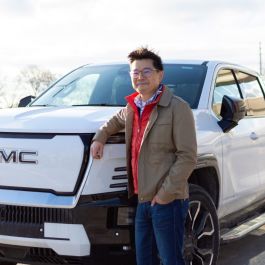
While touchscreens are designed to seem simple and intuitive on the user side, the software powering them is anything but, and must work across a wide range of vehicle models, hardware, variants and market requirements, Fok explained in a GM News blog post.
What drives Fok is the opportunity to build technology he’d want to use himself.
“I’ve always been drawn to smart, useful features…things that make your life easier or add a ‘wow’ factor without being gimmicky,” Fok said.
Infotainment systems are just one example of the type of cutting-edge software GM is scaling in the year ahead. Read on to learn a few different ways the automotive manufacturing company plans to bridge the gap between people and their vehicles — and the opportunities this presents for budding product and engineering talent.
How GM Uses AI and Automation to Scale Infotainment Software
In just the last couple of years, infotainment systems have expanded beyond features like maps and rule-based voice assistants to conversational AI that allows drivers to speak as naturally to their cars as they would a fellow passenger.
According to Fok, rolling out these sorts of features can’t rely on manual testing alone due to the sheer volume.
“That would be impossible,” Fok said.
That’s where automation comes in. Fok said harnessing AI helps ensure consistent performance and reliability across GM’s broad portfolio.
“From my experience, human and machine collaboration frees up more time for meaningful strategic work,” Fok added.
What Is It Like to Work on Global Teams at GM?
GM teams are spread across 25 office locations around the globe, which means employees experience a wide variety of communications styles and cultures. For Fok, the key to successfully leading a global team is understanding that leadership is not “one-size-fits-all.” “Every team is different, especially when you’re working across global regions. What motivates a team in one location might not resonate with another. At GM, I work with colleagues across North America, South America, Asia, and Europe. You have to understand and adapt to each team’s culture and communication style. Flexibility and empathy are key.”
— Stanley Fok, Engineering Group Manager, Infotainment Software
Automation will also help improve scalability and adaptability.
“We’re always looking for ways to streamline development, improve quality, and shorten the time it takes to deliver a polished experience,” Fok said. “Our current infotainment systems are built to support a wide range of features across many vehicles, so the ability to scale and adapt quickly is essential.”
But technology only gets you so far. In order to deliver a great product, Fok said it’s critical to foster a strong team culture of mutual respect, support and shared ownership.
“Everyone is focused on delivering the best possible product, and we help each other get there,” Fok said.
And they’re just getting started.
“From a product standpoint, the technology we’re developing keeps evolving,” Fok said. “With every new vehicle program, there’s something new to learn and new challenges to solve. That keeps things fresh and exciting.”
How GM’s EV and Home Energy Technologies Help Power Homes
Engineers on the Energy team at GM can expect to make a tangible impact on customers during their most vulnerable moments. Because in 2026, GM’s electric vehicles do a whole lot more than drive. Now, some models can help provide power to homes during an outage.
The company recently reported selling more than 246,000 vehicle-to-home capable EVs that can pair with home energy management systems, allowing an owner’s car and house to work together as a team in the event of the grid going down.
Obviously, not everyone can afford an EV, which is why GM Energy is exploring a leasing program for GM Energy’s home energy management systems and PowerBank home batteries.
“How incredible is it that a GM EV can provide power to your properly equipped home, help manage your energy costs, and in the future will work with the grid?" said Wade Sheffer, vice president of GM Energy, in a GM News blog post.
To that end, GM Energy is currently working to certify vehicle-to-grid capability with local utilities, getting closer to a future where cars, homes and the grid work in tandem.
The impact of making this technology more accessible can mean the difference between people having power during a hurricane or being able to lower their electric bill.
“With leasing, we’re removing a barrier and trying to make this technology available to any homeowner, not just GM EV owners,” Sheffer said. “This is about giving people a smarter way to manage their energy and getting more value out of every dollar they spend.”
How GM Engineers Work on AI, Robotics and Autonomous Systems
As the auto industry evolves toward large-scale autonomous systems and next-generation robots, engineers and AI professionals at GM will have the chance to truly shape the next phase of the field.
“Everyone knows GM for our cars and trucks,” Dr. Behrad Toghi, AI & robotics lead at GM, said at NeurIPS, an annual research conference focused on machine learning, artificial intelligence and computational neuroscience. “As the world starts to hear of our progress in areas like AI and robotics, and the massive impact that tech can have, there is a lot of enthusiasm.”
GM’s Autonomous Robotics Center (ARC) in Warren, Michigan, and its sister lab in Mountain View, California, are already leading development efforts in these areas, employing more than 100 experts in robotics, AI and hardware engineering. Their mission? To create intelligent robotic systems that can adapt over time, helping ensure consistent quality across vehicle builds and reducing downtime on the factory floor. In action, that might look like robotics and AI inspecting welds or paint finishes to look for issues before cars roll off the factory line.
For engineers interested in building the next generation of vehicles with a focus on safety, scale and intelligence, GM just might be the place to grow their careers.
Frequently Asked Questions
What technologies do engineers work on at General Motors?
GM engineers work on infotainment software, conversational AI for in-vehicle experiences, EV and home energy technologies, vehicle-to-home and future vehicle-to-grid systems, as well as AI, robotics and autonomous systems. The article also highlights work on touch-screen software that must scale across many vehicle models and hardware variants, plus manufacturing technologies such as intelligent robotic systems.
How does GM use AI in vehicle development?
GM uses AI and automation to help scale infotainment software development and improve quality, consistency and reliability across its vehicle portfolio. AI is also part of newer in-car experiences such as conversational voice interfaces, and it helps free up time for more strategic work by reducing the need for manual testing alone.
How does GM use robotics in manufacturing?
GM uses robotics in manufacturing through collaborative robots, or cobots, on U.S. assembly lines and through the work of its Autonomous Robotics Center and sister lab. Those teams build intelligent robotic systems that can adapt over time and help ensure consistent quality and reduce downtime, including inspecting welds and paint finishes before vehicles leave the factory line.